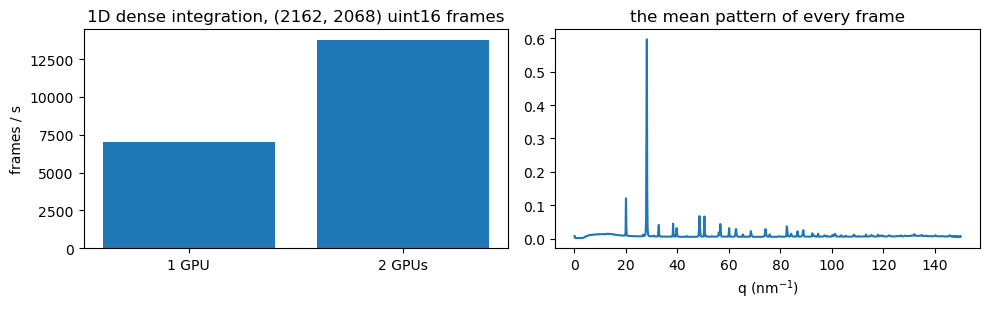
Example 15: Two GPUs: the 1D powder pattern of every frame, on one GPU and then on two
Dense integration: every pixel of every frame goes through pyFAI's sparse matrix, and no sparse pixels are collected (integrate(chunks) of chunk2sparseCSC). Each GPU has its own object (device=0, device=1) driven by its own Python thread; the frames are split in two halves. The decoding and the matrix product run on the GPUs and the threads mostly wait for them, so two GPUs should take about half the time of one, unless the host cannot feed them (copying the compressed chunks into pinned memory, the uploads). Each call's powder comes back to the host, as it would for writing it out. The chunks are read from the file once, before the clock starts, and passed over several times so that each run takes long enough to time. With one GPU, only the one-GPU time is shown.
Source: examples/ex15_two_gpus.py, run as python examples/ex15_two_gpus.py, or download the notebook (figures and output as run when this page was built).
Output, from running it on real data when this page was made: silicon_u16_zstd2_256k.h5 of the example data (https://doi.org/10.5281/zenodo.23361659) repacked as lz4 by tools/example_data.py, with its mask.h5 and tools/calib.poni. This page is committed, made by tools/real_data_pages.py; CI does not run it on this data.
import os
import platform
import threading
import time
os.environ["BSLZ4_CUDA_BACKEND"] = "driver" # set before bslz4_to_sparse.cuda is imported
import h5py
import hdf5plugin  # registers the bitshuffle filter, so that h5py can decompress too
import matplotlib.pyplot as plt
import numpy as np
import pyFAI
from pyFAI.method_registry import IntegrationMethod

from bslz4_to_sparse import cuda
h5filename = "eiger_0000.h5"  # your file: bitshuffle-lz4 (8 kB blocks), one frame per chunk
h5dataset = "/entry_0000/ESRF-ID11/eiger/data"  # the (nframes, ni, nj) dataset inside it
mask_filename = (
    "mask.h5"  # your detector mask: a dataset "mask", pyFAI's convention (non-zero = masked)
)
poni_filename = "calib.poni"  # your pyFAI geometry
frames_to_time = 10000  # the file's frames, passed over until there are this many
per_call = 128  # frames per integrate() call
with h5py.File(h5filename, "r") as h5:
    ds = h5[h5dataset]
    dtype = ds.dtype
    file_chunks = [ds.id.read_direct_chunk((i, 0, 0))[1] for i in range(ds.shape[0])]
    frame0 = ds[0]
with h5py.File(mask_filename, "r") as h5:
    bad = h5["mask"][()] != 0  # the masked pixels
mask = (~bad).astype(np.uint8)
passes = max(1, -(-frames_to_time // len(file_chunks)))
chunks = file_chunks * passes
print("%d frames of %s %s: the file's %d, %d times; %.1f MB compressed"
      % (len(chunks), frame0.shape, dtype, len(file_chunks), passes,
         sum(len(c) for c in chunks) / 1e6))
10000 frames of (2162, 2068) uint16: the file's 250, 40 times; 1496.2 MB compressed
ai = pyFAI.load(poni_filename)
method = IntegrationMethod.select_one_available(("bbox", "csc", "cython"), dim=1)
ref = ai.integrate1d(frame0, 1000, unit="q_nm^-1", method=method, mask=bad)
engine = ai.engines[method].engine
ngpu = min(2, cuda.device_count())
gpus = [cuda.chunk2sparseCSC(mask, engine, dtype, device=d) for d in range(ngpu)]
print("%s; GPUs: %s" % (platform.machine(),
                        ", ".join(cuda.device_name(d) for d in range(ngpu))))
for g in gpus:  # first calls: buffers allocated, kernels loaded
    g.integrate(chunks[:per_call])
ppc64le; GPUs: Tesla V100-SXM2-32GB, Tesla V100-SXM2-32GB
def integrate_on(devices):
    """Every frame's powder (host array) and the seconds it took, the frames split over devices."""
    parts = np.array_split(np.arange(len(chunks)), len(devices))
    out = [None] * len(devices)

    def work(k):
        g, idx = gpus[devices[k]], parts[k]
        out[k] = np.concatenate([
            g.integrate(chunks[idx[s]: idx[s] + len(idx[s: s + per_call])]).get()
            for s in range(0, len(idx), per_call)
        ])

    threads = [threading.Thread(target=work, args=(k,)) for k in range(len(devices))]
    t0 = time.perf_counter()
    for t in threads:
        t.start()
    for t in threads:
        t.join()
    return np.concatenate(out), time.perf_counter() - t0
powder1, t1 = integrate_on([0])
assert np.allclose(powder1[0], ref.sum_signal, rtol=1e-9, atol=0)  # pyFAI's sums for frame 0
rates = {"1 GPU": len(chunks) / t1}
print("1 GPU : %6.3f s, %6.0f frames/s" % (t1, rates["1 GPU"]))
if ngpu == 2:
    powder2, t2 = integrate_on([0, 1])
    assert np.array_equal(powder1, powder2)  # the same sums, bit for bit
    rates["2 GPUs"] = len(chunks) / t2
    print("2 GPUs: %6.3f s, %6.0f frames/s, %.2f times one GPU" % (t2, rates["2 GPUs"], t1 / t2))
else:
    print("one GPU here: no two-GPU run")
1 GPU :  1.432 s,   6985 frames/s
2 GPUs:  0.726 s,  13779 frames/s, 1.97 times one GPU
fig, axes = plt.subplots(1, 2, figsize=(10, 3.2))
axes[0].bar(list(rates), list(rates.values()))
axes[0].set_ylabel("frames / s")
axes[0].set_title("1D dense integration, %s %s frames" % (frame0.shape, dtype))
norm = np.asarray(ai.integrate1d(np.ones(frame0.shape, np.float32), 1000, unit="q_nm^-1",
                                 method=method, mask=bad).sum_normalization)
axes[1].plot(ref.radial, powder1.mean(axis=0) / np.maximum(norm, 1e-30))
axes[1].set_xlabel("q (nm$^{-1}$)")
axes[1].set_title("the mean pattern of every frame")
plt.tight_layout()
plt.show()
Generated by tools/real_data_pages.py from bslz4_to_sparse 0.0.22a1 (git None, sources sha256 6929bd75ab7a).